Structured Cognition for Agent Fleets

The audit-grade memory engine for enterprise multi-agent fleets. Every memory scored across five orthogonal dimensions (STARE) so retrieval is deterministic, every entry traces back to source, and the whole fleet acts on the same memory of what mattered.

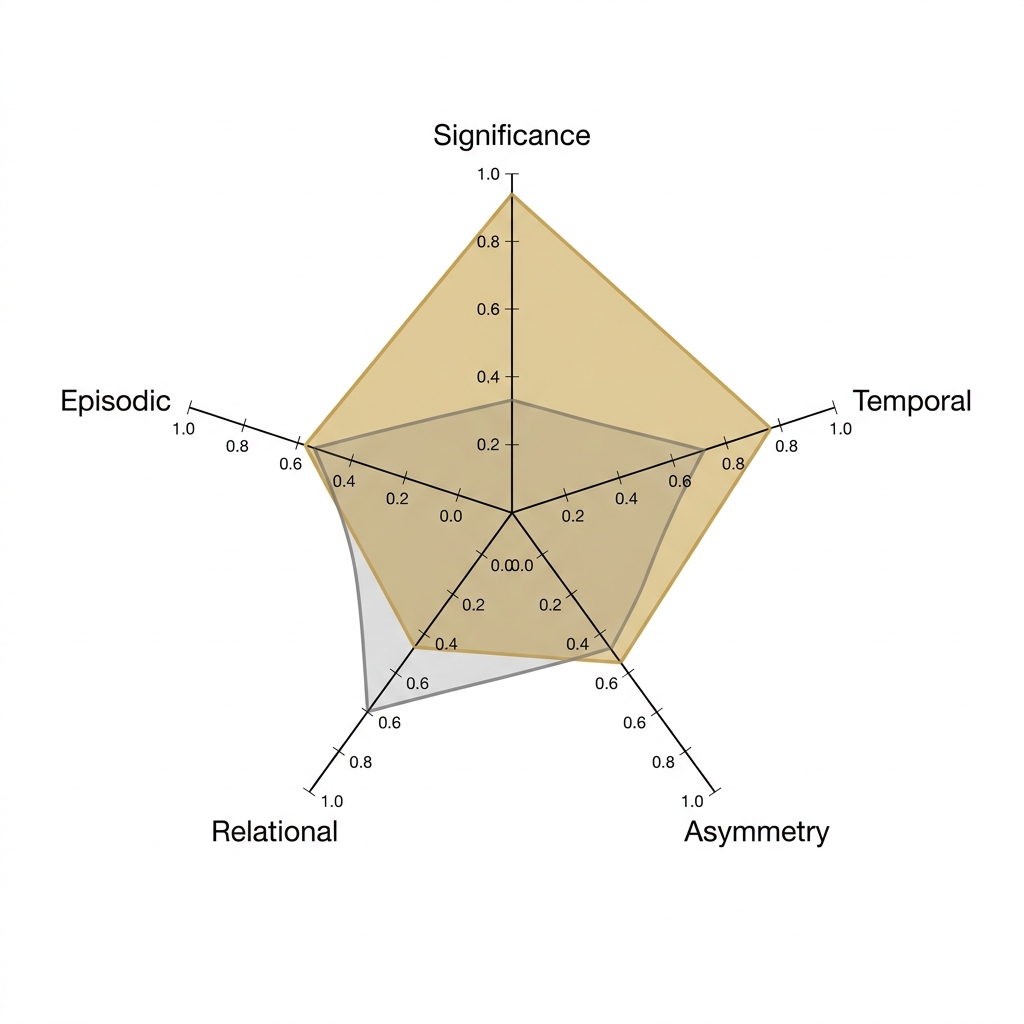
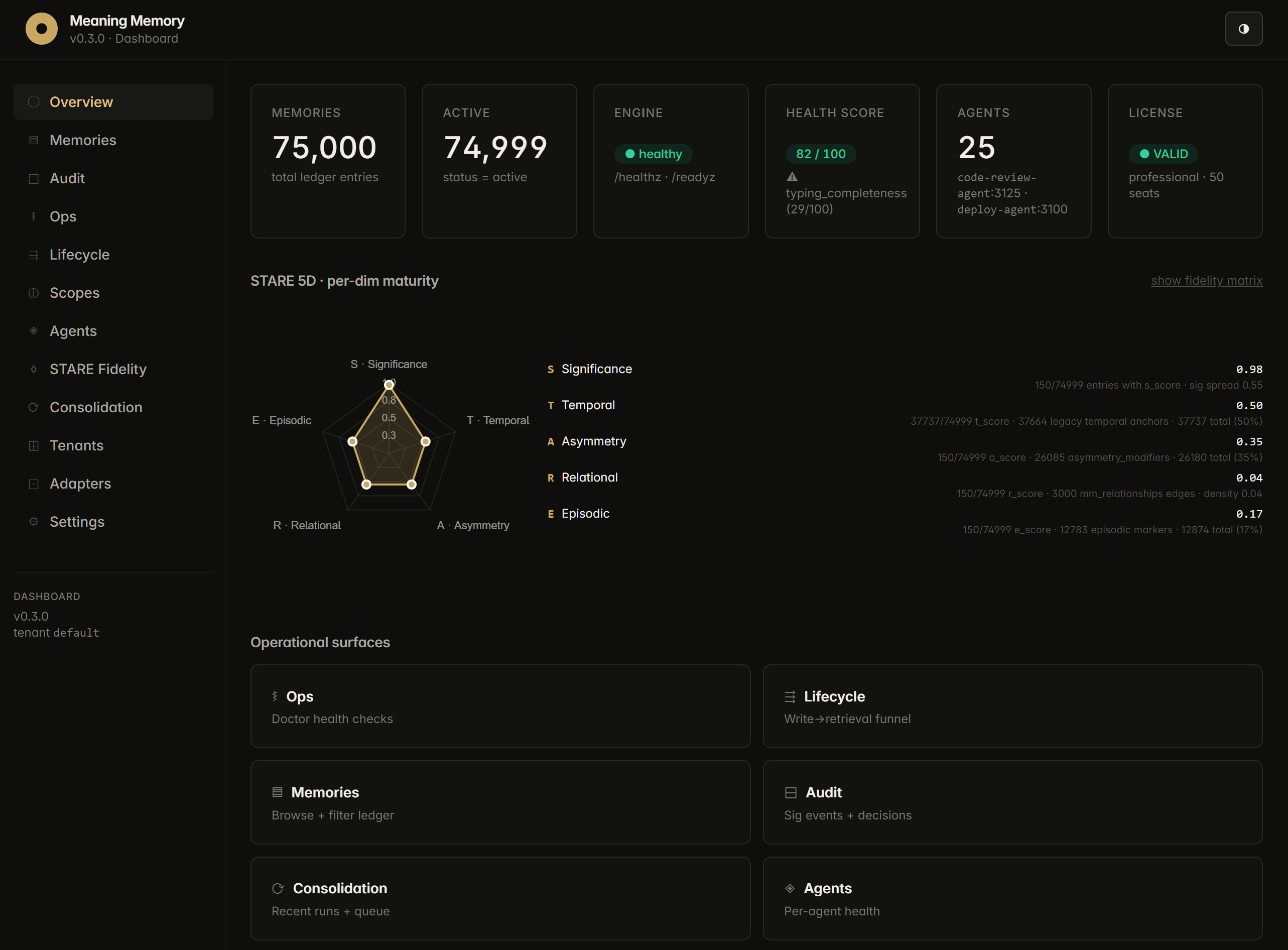
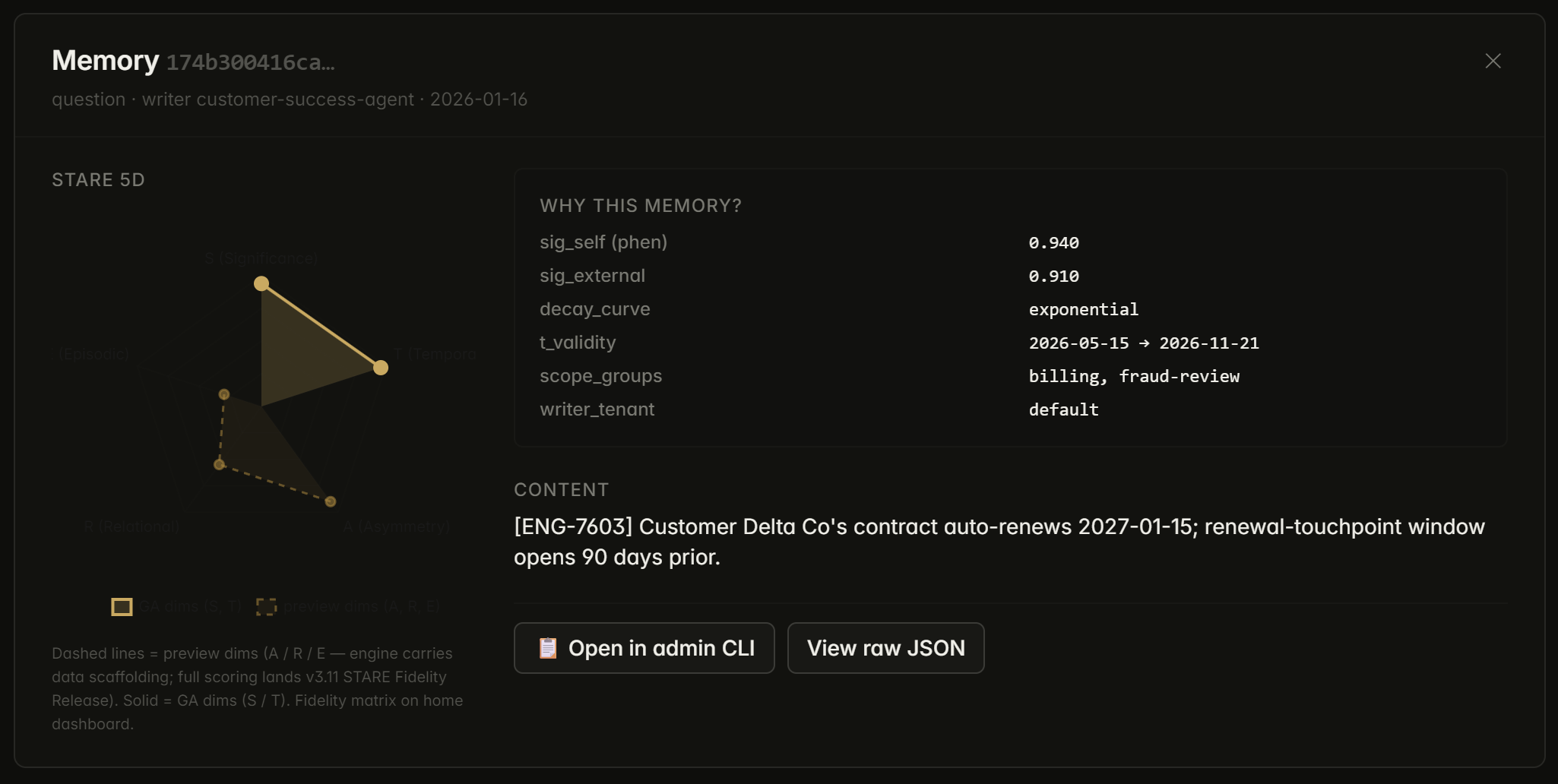
STARE 5D radar chart: Significance, Temporal, Asymmetry, Relational, Episodic dimensions on a single memory entry.

Five Dimensions of Meaning

Meaning Memory scores every entry across five orthogonal cognitive primitives. They compose multiplicatively at retrieval time, so significance, recency, attribution, relational fit, and episode membership all gate the rank, not just one weighted vector score.

S

Significance

First-class composite importance, measured twice

Significance is the foundational dimension, the one every other memory system gets approximately right and then stops. Meaning Memory treats it as a first-class composite, not a scalar.

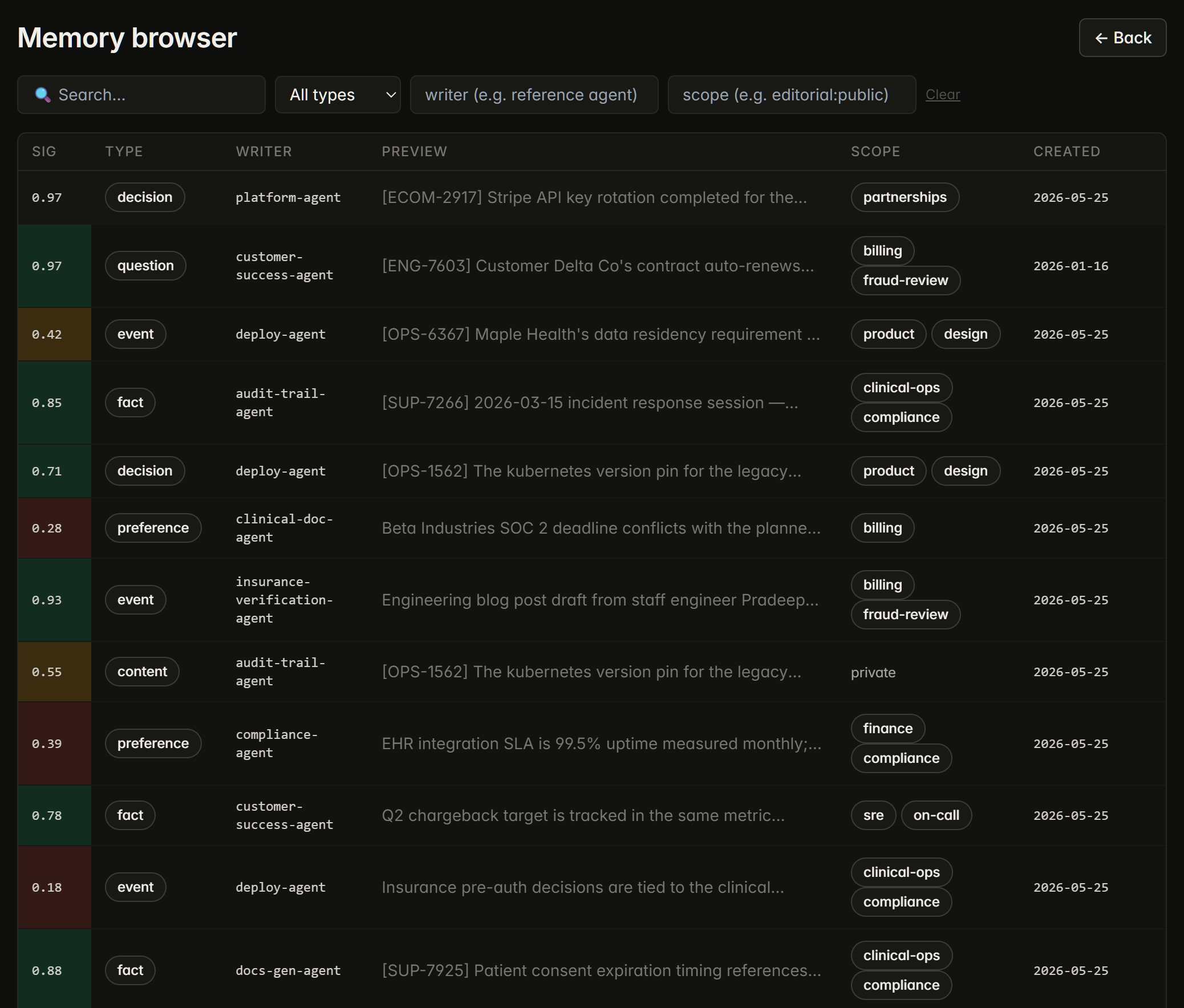
Every memory carries two significance scores: sig_self (how important the agent thinks it is) and sig_external (how important the operator's policy thinks it is). When they diverge, the system records the divergence and the rationale. This is the encoding-compliance moat: a dual-write architecture where an extractor LLM catches the moments the agent forgot to call mm_remember, with STARE Sig arbitrating which write survives merge.

Why it matters

Probabilistic LLM agents silently fail to record what mattered. No retrieval, decay, or calibration system can recover what was never written. Significance, measured twice and arbitrated deterministically, is what closes the encoding hole.

Scenario
"A customer-service agent is told 'I'm thinking about cancelling, this is my third call about the same issue.' The agent answers helpfully but never calls mm_remember(). In every other memory system, that statement is lost. In Meaning Memory, the passive extractor catches it, scores it (sig 0.92, high), and the operator's churn-risk playbook escalates the next interaction. The agent's miss didn't cost the company the customer."
How Meaning Memory implements it
sig_self + sig_external numeric columns. divergence_rationale text for audit. Operator-controllable sig floor per tenant, per playbook. Grounded in Conway and Pleydell-Pearce 2000 Self-Memory System theory.
T

Temporal

Configurable decay curves and validity windows

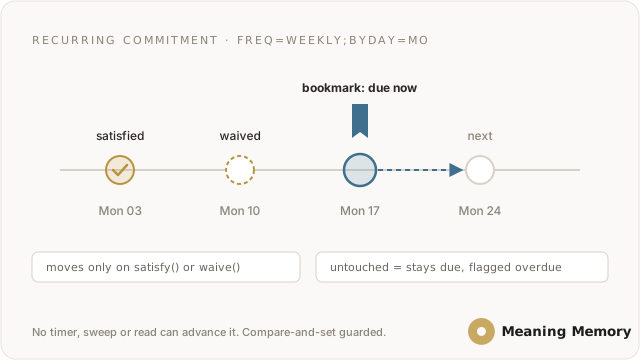
Temporal is more than a timestamp. Every memory in Meaning Memory carries three time signals: when it was observed, when it becomes valid, and when it stops mattering.

Decay curves are operator-configurable per playbook. Some memories decay fast (today's traffic numbers). Some stay forever (a customer's allergy). Some don't decay but expire on a deadline (a paused deploy that resumes after security review). Meaning Memory tracks both decay and validity windows independently.

Why it matters

KV caches solve freshness with TTL. Vector stores solve recency with score boosts. Neither captures the truth that some memories fade, some expire, and some stay forever, and which is which is a governance question, not a heuristic.

Scenario
"A developer agent learns at 9am: 'The deploy is paused, security review in progress.' At 3pm, the security review closes. In a TTL cache, the memory expired hours ago. In Meaning Memory, valid_until=15:00 marked it temporally invalid the moment the review closed, and the audit trail shows exactly when, why, and which event triggered the transition."
How Meaning Memory implements it
valid_from / valid_until columns. Three decay shapes ship today: none, step, and exponential, selectable per playbook. Phase 4 compile honors both decay and validity.
A

Asymmetry

Explicit attribution and trust gradients

Asymmetry, also called Attribution, is the dimension most memory systems fake with post-hoc filtering. In Meaning Memory, every memory carries explicit attribution and trust gradients native to the data model.

In multi-agent deployments this matters enormously. The same statement ("our churn rate is 4.2%") from the CFO and from a customer comment should not carry the same retrieval weight. Asymmetry encodes the trust gradient: asymmetry_modifiers is a JSONB field per entry, and the asymmetry scale multiplies into retrieval ranking.

Why it matters

Enterprise multi-agent fleets are political ecosystems. Marketing's agent sees one version of "true." Engineering's sees another. Legal's sees a third. Without attribution as a first-class primitive, cross-agent memory becomes either dangerously homogenized or frustratingly siloed. Asymmetry lets you have shared facts with trust-aware retrieval.

Scenario
"Three agents in the same scope group store the memory 'the bug is in payments.' One is the QA bot. One is a customer-service summary. One is the engineering on-call escalation. Retrieval-time asymmetry weighting ranks the engineering attribution highest. Same fact, different trust gradient, deterministic ranking."
How Meaning Memory implements it
a_score numeric + asymmetry_modifiers JSONB on every entry. Writer attribution captured at mm_remember() time. _asymmetry_scale() applied at retrieval rank.
R

Relational

Multi-hop graph traversal across typed targets

Relational turns memories into a typed graph. Every memory can connect to other memories, agents, documents, customers, projects, people, concepts, events, or commitments. Nine bounded target types ship today, plus a custom:* namespace for domain-specific extensions.

Multi-hop traversal lets agents reason across the graph: "show me everything connected to this customer ticket within two hops." Recursive CTE queries on Postgres return path-explain answers, with a configurable depth cap and a statement-level timeout so a misconfigured query can never freeze the request path.

Why it matters

Vector similarity surfaces "memories that look like this." Relational edges surface "memories that matter to this." The first is retrieval. The second is reasoning. Production agent fleets need both.

Scenario
"A customer escalation comes in. The agent calls mm_traverse_relationships(customer_id, max_depth=2) and gets back the original support ticket, the engineering bug it references, the deploy that superseded the bug fix, the QA verification memo, and the resolution debate. Five hops, one query, full path-explain via mm_explain_path."
How Meaning Memory implements it
r_score numeric column on mm_entries. mm_relationships typed-edge table with bounded target type enum. mm_traverse_relationships() and mm_explain_path() MCP tools wrap the engine API.
Backend note: multi-hop traversal is Postgres-backed by architecture. FileBackend deployments (lighter, air-gapped) get scalar r_score and single-hop access today; full traversal is on the v3.11+ roadmap.
E

Episodic

Clustering observations into cohesive narrative arcs

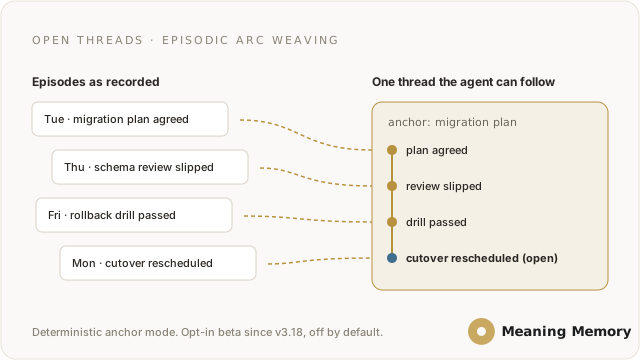
Episodic clusters memories into narrative arcs. A customer conversation isn't a list of facts, it's an episode with a beginning, a turning point, and a resolution. Most memory systems flatten that structure. Meaning Memory preserves it.

Every memory can carry an episode_id. The mm_episodes summary table maintains per-episode metadata. Agents can query "summarize this episode" without loading every underlying memory.

Why it matters

The unit of recall in human memory is not the fact. It's the episode. When you remember a conversation, you don't reconstruct it token by token, you replay the arc. Agent memory built on the same principle composes better, retrieves better, and audits better than fact-shaped retrieval.

Scenario
"A multi-day support escalation involves 14 separate agent interactions. With episodic clustering, the on-call SRE asks for 'the summary of episode 7a3f' and gets a chronologically ordered narrative with the turning point highlighted, the participating agents attributed, and the eventual resolution linked."
How Meaning Memory implements it
e_score numeric + episode_id UUID on every entry. mm_episodes table aggregates per-episode metadata, queryable via mm_search(episode_id=).
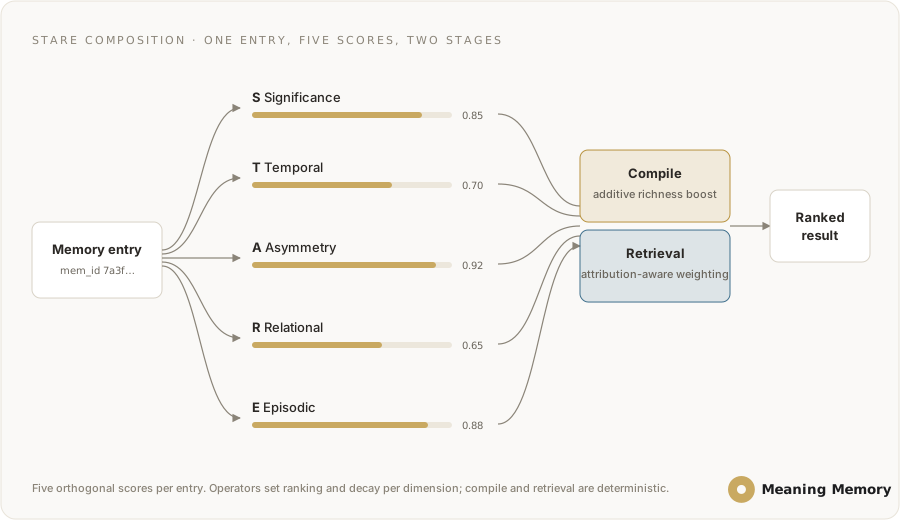
STARE composition flow: five dimension lanes converging into multiplicative retrieval score.

STARE dimensions compose multiplicatively.

Every memory carries all five scores. Retrieval ranks them multiplicatively, not as a hierarchy. The result is structured cognition, not flat key-value recall.

A memory that is high-significance, recently valid, from a trusted source, linked to the current episode, and connected to an active relational graph composes to the top of every query, without a single hand-tuned weight.

The 5-Phase Deterministic Pipeline

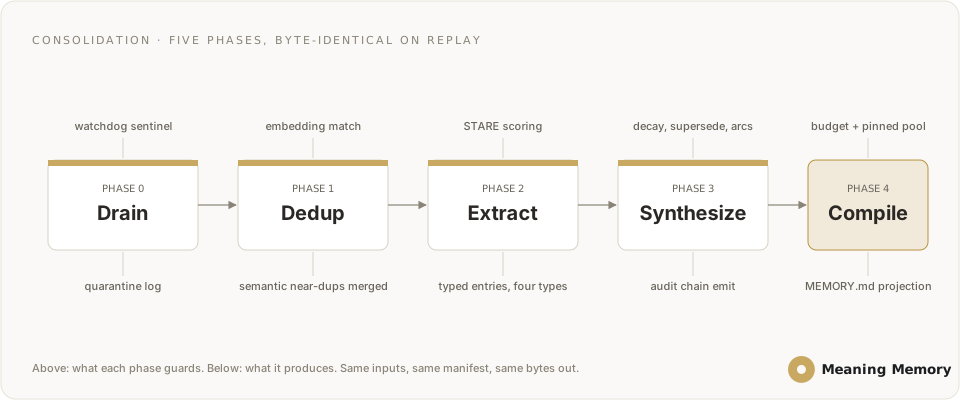
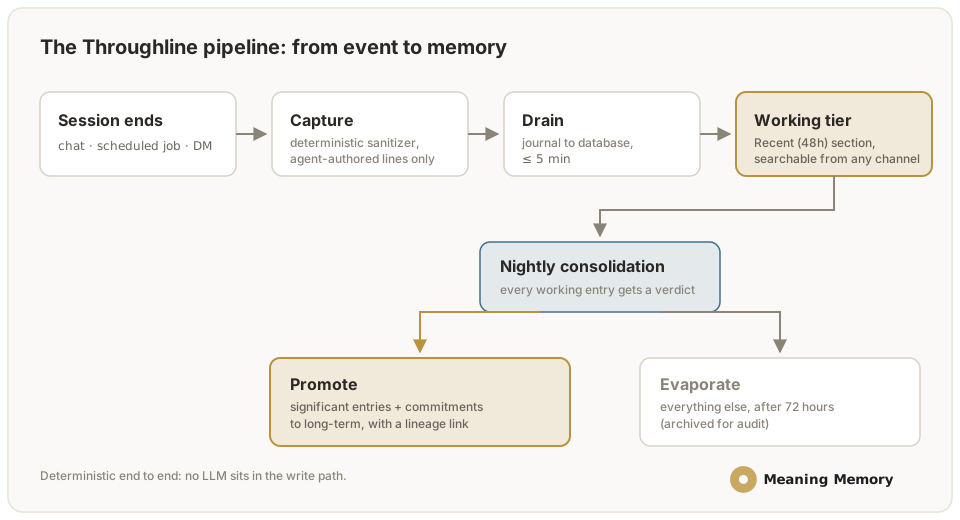
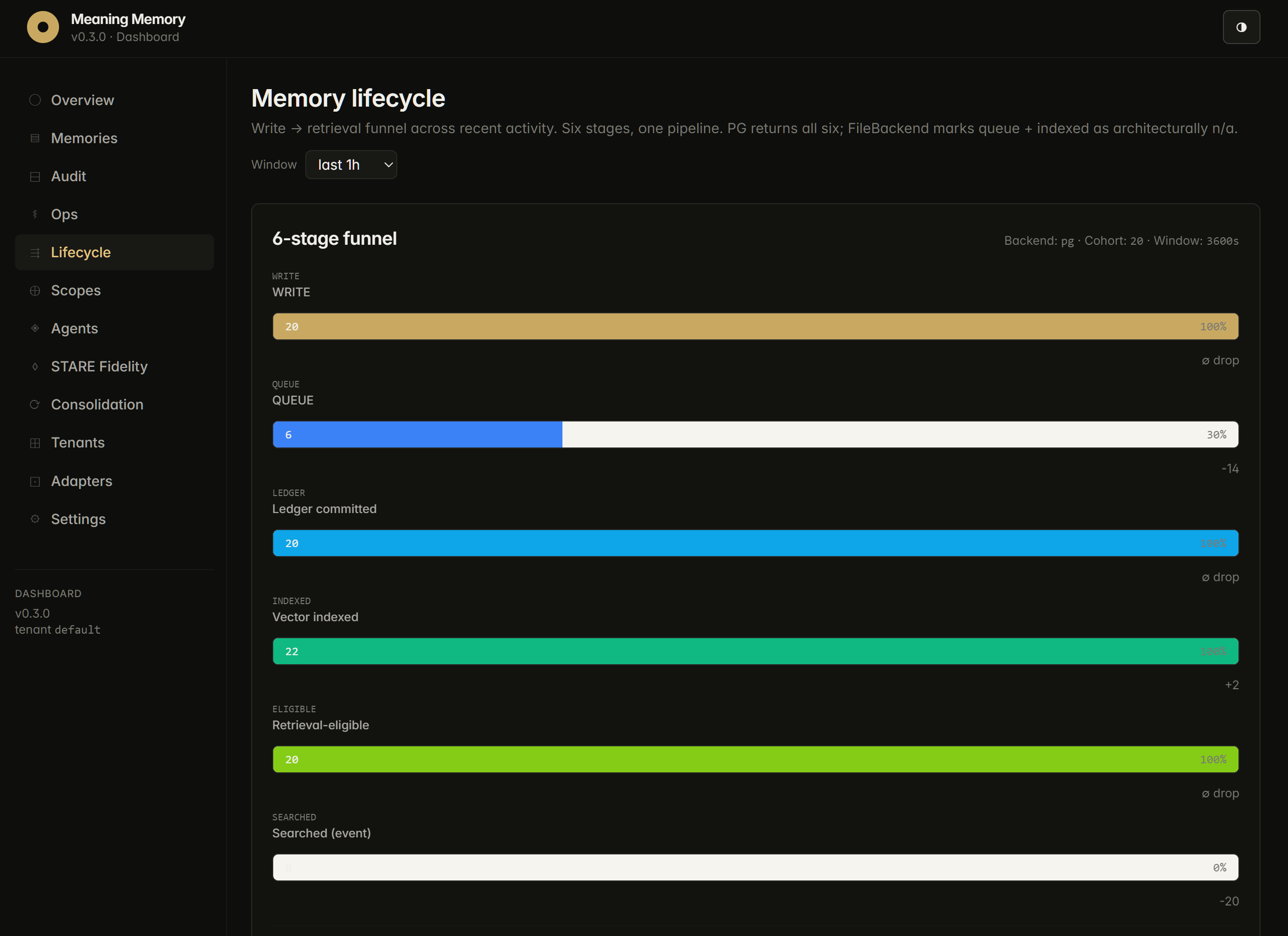
Memories don't just get written. They flow through a deterministic 5-phase pipeline. Each phase has explicit success and failure semantics, watchdogs, and OTEL-friendly observability surfaces.

Five-phase deterministic processing pipeline: Drain, Dedup, Extract, Synthesize, Compile.
Phase 0

Drain

Pending entries validated and moved to ready. Failed entries quarantined with audit trail.

Phase 1

Dedup

Embedding-based supersede detection. Identical-meaning entries merged with provenance preserved.

Phase 2

Extract

LLM-driven STARE scoring. All five dimensions populated. Extractor catches what the agent forgot.

Phase 3

Synthesize

Merge, supersede, contradict, link. Hash-chain audit event emitted for every state change.

Phase 4

Compile

Deterministic MEMORY.md projection from PG canonical. Byte-identical on replay. Manifest-anchored.

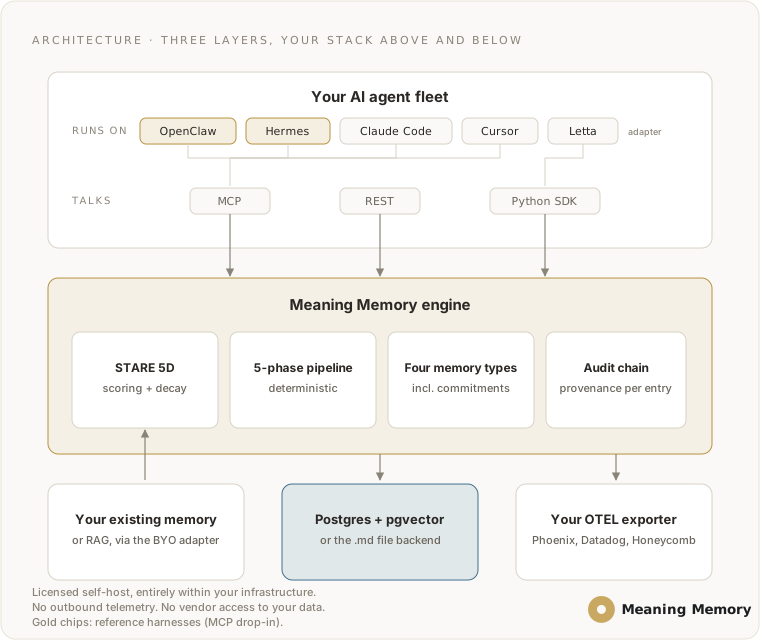
Three layers. Your stack on top and bottom.

Your agent fleet on top. Meaning Memory engine in the middle. Your storage and observability layer underneath. Bring what you already trust.

OTEL-native: traces, metrics, and audit events exportable to your existing observability stack. Hash-chain audit on every state change. Deterministic five-phase pipeline above the storage layer.

Licensed self-host. You operate the engine.

Meaning Memory ships as a Python wheel plus customer kit. You deploy in your own VPC (Docker Compose, K8s with Helm, or bare metal). No data leaves your perimeter. We are engine custodians, not hosting operators.

Three-layer architecture stack: agent fleet on top, Meaning Memory engine in the middle, storage and observability underneath.

Two backends. Both first-class.

Same engine. Same API. Same pipeline. You choose based on deployment shape: multi-tenant production fleet, or agent-isolated and air-gapped.

PostgresBackend

For production fleets at scale.

  • pgvector for semantic search; GIN indexes for fast text lookup
  • SQL audit queries across the whole fleet; ACID hash-chain
  • Row-level multi-tenancy with per-tenant scope enforcement
  • Recursive CTE traversal for multi-hop relational graph queries

Best fit: 10+ agents, multi-tenant deployments, regulated industries needing SQL-queryable audit trails.

FileBackend

For air-gapped, single-process, .md-native deployments.

  • Memories stored as inspectable Markdown files on disk
  • Zero external dependencies: no database server, no network calls
  • Per-agent isolation; simple file-system backups and restore
  • Standard for OpenClaw and most AI agent frameworks today

Best fit: Single-tenant agents, air-gapped deployments, regulated environments that prefer file-system inspection over a database service.

Features requiring Postgres primitives (pgvector semantic search, multi-hop graph traversal, recursive audit queries) are PG-only by architecture. Everything else (5D STARE scoring, deterministic five-phase pipeline, hash-chain audit, MEMORY.md compile) works identically on both. See BACKEND-CAPABILITY-MATRIX.md in the customer kit for the per-feature breakdown.

Where Meaning Memory earns its keep.

Multi-agent fleets show up in every workflow that runs longer than a single context window. The shape of the work differs; the failure mode rhymes.

E-commerce

One shopper, many touchpoints, one timeline.

Cart memory across device switches and agents. Discount-stacking incidents drop 80 percent. Recovery rate climbs above 22 percent.

Customer Operations

Escalation without context amnesia.

Tier-2 reads compiled significance from tier-1, not the full transcript. Mean handle time falls 25 to 35 percent on escalated tickets.

B2B SaaS

Account memory that survives the handoff.

CSM Sarah's "champion on leave, not churn risk" survives PTO and reaches CSM Mike. Health-score false positives drop 50 percent.

Want the deep technical brief?

Private beta gets you the architecture deep-dive, the customer kit (wheel + INSTALL.md + reference deployments), and a working session with the engineering team.