From Context Window to Memory Layer: A CTO's Guide
The context window is where every agent project starts and where most of them quietly hit a ceiling. This is a CTO-level guide to why that ceiling appears, what a memory layer actually is, and how to tell a real one from a fast cache.
By Clinton Stark • explainer, memory-layer, ai-agents, enterprise-ai, cto-guide, series
When you build your first agent, the context window feels like the most important thing in the world. You write a good system prompt, paste in a few documents, and the model holds it together well enough that the plan seems obvious: when it needs to know more, give it more. For a demo, that (mostly) works. For an assistant that remembers a name for the length of a chat, it also usually works. It keeps working right up until the agent has to recall which client approved which contract, which compliance rule changed last quarter, and which project is currently blocked. That is the moment the context window stops being a feature you feed and becomes a ceiling. A model can only read so much in a single request, so past a certain point “just give it more” stops working: cost climbs, the signal gets buried, and details quietly drop out.
I have spent almost a year building a memory engine for agents, and the most useful thing I can offer another technical leader is not a pitch. It is a way to see these limitations early, before it costs you a re-architecture. So this is the guide I wish I had read first: why the context window runs out, what a memory layer actually is, and how to tell a real one from a fast cache essentially wearing the same label.
The context window is a buffer, not an architecture
The context window is your first data layer by accident. It is right there, it is easy, and for a while it is enough. The trouble is that it was designed to be a reading buffer for one request, and you are slowly asking it to be your agent’s long-term memory. Those are different jobs, and the gap shows up in four predictable ways.
- Cost scales with the archive, not the task. Every token you carry is billed on every call, and most of those tokens are the same baseline context re-sent for the hundredth time. The marginal cost of “just one more document” is never zero, and at fleet scale it is the line item nobody forecast.
- Signal-to-noise falls as you add more. Past a point, more history makes the agent worse. It spends attention re-reading what it already knows and has less left for the decision in front of it. The thing that matters most gets buried in the middle, which is exactly where models attend least.
- Consistency quietly degrades. Reorder the same context and you get a different answer. The model rewards recency and proximity, not importance, so output stability becomes a function of prompt assembly rather than of what is true.
- There is no provenance. The model can repeat a policy but cannot tell you which version it read or whether that version was superseded yesterday. For anything audited, an answer you cannot attribute is a liability, not a feature.
None of these are edge cases. They are the default behavior of any system that treats memory as a prompt-engineering problem instead of an architecture problem.
What changes when memory becomes a layer
A memory layer is a dedicated part of your stack that lives between the agent and its data. Not an API you call at the last second, and not a vector store bolted onto a prompt, but a layer with its own job: decide what is worth remembering, keep it, and hand back only what the current task needs. Treating memory that way changes three things at once.
| Context window | Memory layer | |
|---|---|---|
| Lifetime | Resets every session | Persists across sessions |
| When you curate | At prompt-build time, by hand | At storage time, by scoring |
| Cost as data grows | Linear and unbounded | Roughly flat working context |
| Provenance | None | Source, version, timestamp per entry |
| Across agents | Copy-paste between prompts | Shared or walled off by rule |
Memory becomes persistent, not transient. The agent arrives knowing what it was working on yesterday instead of being re-injected with its whole history on every call. Continuity stops being something you simulate in the prompt.
Retrieval becomes curation. A context window forces the include-or-exclude decision at the worst possible moment, while you are assembling the prompt. A memory layer makes that decision once, at storage time, by scoring each entry for how much it is likely to matter. The agent stops paying tokens to wade through low-signal noise.
Scale becomes linear in cost, not exponential in complexity. Adding data no longer grows the prompt. The layer absorbs the indexing, ranking, and retrieval, so you can add thousands of documents, hundreds of users, and years of history while the agent’s working context stays bounded.
Not every “memory layer” is the same layer
This is the part that matters most at evaluation time, because the category is crowded and the labels have blurred. It helps to sort the options into three tiers, because they solve different problems and only one of them is doing the job a CTO actually has in mind.
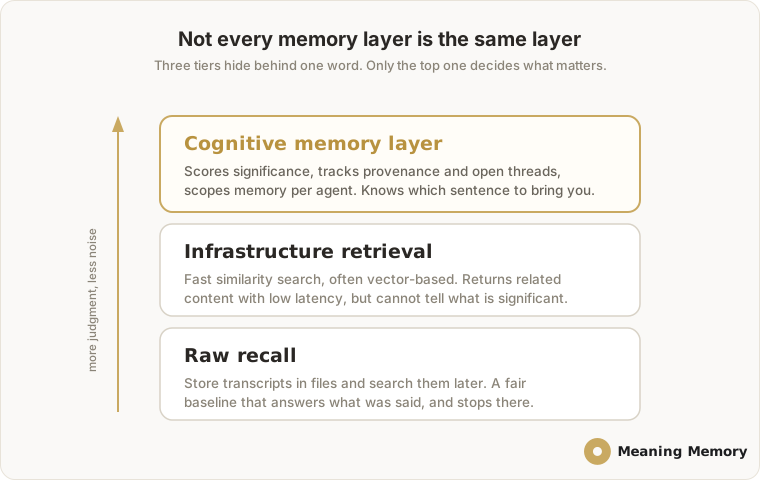 The three tiers most products labelled “memory” actually occupy. Only the top tier decides what matters.
The first tier is raw recall. Drop transcripts into files or a plain store and search them later. It is a real baseline, and recent work showing strong recall scores from little more than a filesystem is a fair reminder that you should not over-engineer a problem you do not have. But raw recall answers “what was said” and stops there. It has no notion of what mattered, no provenance, and no boundaries between agents.
The second tier is infrastructure-grade retrieval: a fast, scalable store, often vector-based, that returns similar content with low latency. This is genuinely useful and increasingly well marketed as a “context layer.” What it optimizes is speed and similarity. What it does not decide is significance. Two passages can be equally similar to a query and wildly different in importance, and a retrieval tier treats them the same.
The third tier is a cognitive memory layer, and it is the one the rest of this guide is about. On top of fast retrieval it adds the judgments a colleague makes without thinking: this matters more than that, this came from here and was true as of then, this belongs to the finance agent and not the support agent, this is an open thread the team has not closed yet. That is the difference between a system that can find a sentence and a system that knows which sentence to bring you.
When a vendor says “memory,” figure out which tier you are buying. A recall store and a cognitive layer are both correct answers to questions a CTO is not always asking.
What to evaluate
When your team decides to build or buy, these are the dimensions that separate the tiers in practice.
Provenance. Can the agent cite which document, which version, and which timestamp an answer came from? Without it, the agent is generating, not retrieving, and you cannot defend the output in an audit.
Significance scoring. Does the layer rank by importance, or only by similarity? Scoring across several dimensions, recency, importance, relationship, and task relevance, returns better context than vector distance alone, and it is the single clearest line between the retrieval tier and the cognitive one.
Self-hosting. If your agents touch regulated, sensitive, or proprietary data, the memory should never leave your infrastructure. A managed memory API is fast to adopt and is also a data-residency decision you are making on behalf of your compliance team, so make it on purpose.
Multi-agent scoping. Production agents do not work alone. They share tools and reference each other’s work, and some of what they hold must never cross a team line. The layer should let you declare what is shared and what is walled off, and enforce that boundary in the data rather than in a hopeful instruction to the model.
Latency. Retrieval has to be faster than the decision it informs. If the memory layer adds more delay than it saves in prompt efficiency, it is not earning its place in the request path.
A useful habit: ask each vendor not whether they “have memory,” but how they answer these five. The differences get crisp fast.
Where Meaning Memory fits
Meaning Memory is a licensed, self-hosted memory engine built for exactly this shift. It is not a vector database and not a prompt template. It is the cognitive tier described above, running inside your own infrastructure.
In the terms above, it scores every memory with STARE 5D (Significance, Temporal, Asymmetry, Relational, Episodic) so the agent receives prioritized context rather than merely retrieved context; it tracks open threads, the ongoing projects and unresolved commitments that tell an agent what is happening now and not just what was said before; it attaches source, version, and timestamp to every entry so answers carry attribution; it keeps memory private by default and shareable by explicit scope, so collaboration and isolation are both enforced in the data; and it holds the agent’s working context roughly flat as the data behind it grows. You run it; we maintain the engine; your memory data stays on your side of the wall.
The bottom line
The context window is a fine tool for small agents and a poor foundation for serious ones. When your agents have to operate across users, across sessions, and across teams, it becomes the bottleneck that no other optimization can route around, because the problem is not the size of the buffer. It is that a buffer was never supposed to be the memory.
A memory layer is not a bigger context window. It is a different layer of the stack, one that does what the model cannot: keep what matters, know where it came from, and bring back only what the moment needs. If you are building agents meant to remember what matters rather than what was most recently said, the question stops being whether to add a memory layer. It becomes which tier you are actually buying.
Common questions
What is the difference between a context window and a memory layer?
A context window is the text an LLM can read in a single request. It is temporary, it resets every session, and everything in it is re-sent and re-billed on every call. A memory layer is a dedicated part of your stack that sits between the agent and its data. It persists across sessions, decides at storage time what is worth keeping, and returns only the most relevant pieces for the task in front of the agent. The context window is a buffer. The memory layer is infrastructure.
When does an AI agent actually need a memory layer?
When the agent has to be right across sessions, across users, or across teams. A single-session chatbot is fine on the context window alone. The moment an agent needs to recall a decision from last quarter, attribute a fact to a specific document version, or pick up a task it started yesterday, you have outgrown the context window and you are choosing a memory layer whether you call it that or not.
Isn’t a bigger context window or a vector database enough?
Both help and neither is a memory layer. A bigger window pushes the ceiling higher but keeps the same problems: linear cost, falling signal-to-noise, and no provenance. A vector database gives you similarity search, which is one retrieval method, not a memory system. A memory layer adds the parts a database leaves out: significance scoring beyond raw similarity, source and version provenance, persistence across sessions, and rules for what is shared between agents and what stays private.
Should an enterprise build or buy an agent memory layer?
Build it only if memory is going to be a core product differentiator you intend to maintain for years. For everyone else, the engineering surface is larger than it looks once you account for scoring, provenance, multi-agent scoping, retention, and audit. The deciding question is usually control: if your agents handle regulated or sensitive data, choose a memory layer you can self-host so the data never leaves your infrastructure.
How does a memory layer keep token costs from growing with usage?
By moving the curation decision from query time to storage time. Instead of stuffing every potentially relevant document into the prompt, the memory layer scores each entry when it is written and returns only what matters for the current task. The working context stays roughly constant even as the data behind it grows into thousands of documents and years of history, so cost tracks the task, not the archive.
This is the latest post in the Meaning Memory Explained series. Related reading: What Is AI Agent Memory?, How Agents Share Memory Across the Enterprise, and Your AI Agents Need an Org Chart, Not a Better Prompt.