Your AI Agents Need an Org Chart, Not a Better Prompt
Deploying AI agents is an organizational decision before it is a technical one. The decisions that decide whether a fleet works, who owns what, who can see what, who is accountable for what, and how a memory layer implements each.
By Clinton Stark • explainer, org-design, ai-agents, series
When we started building this, I cared about the model as much as anyone. It’s the fun part to argue about, with a new leaderboard every couple of weeks and the feeling that picking the right one is the most important call you’ll make. But over a few months of building a memory engine and talking with teams about what actually goes wrong when they put agents to work, I slowly came to see it differently, because the model kept turning out to be the easy part. What broke, again and again, was the quieter stuff that never makes it onto a slide: who owns what, who can see what, and who’s on the hook when something simply doesn’t happen.
Which is really just to say that an AI fleet is a team, and teams need an org chart. Not a literal one, but the same set of decisions you’d make about people, and those decisions tend to outlast whatever model is running underneath them. The trouble is that almost nobody makes them deliberately. So these are the ones I’d settle before turning on a single agent, in roughly the order we ran into them. (An earlier piece in this series looked at why agent memory matters at all; this one’s about organizing it around the way your business already works.)
1. Organize agents by function, not by model
Your company already has an org chart, so you may as well use it. Early on, the instinct is to build one agent that does everything. That’s exactly what we did, and it turned into a mess. A generalist’s memory becomes a junk drawer fast: pile finance notes, support tickets, and half-finished editorial ideas into the same box and you stop trusting what the agent tells you. The fix, when we found it, was unglamorous. We mapped agents to functions the way you’d map people to roles, gave each its own scoped memory, and let it specialize. A few months in, the finance agent actually knew finance, and that turned out to be most of the trick.
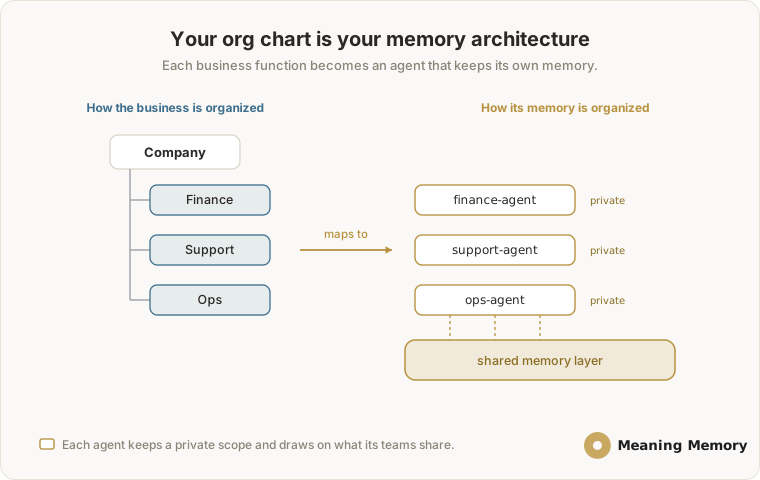 Map agents to functions, and your org chart becomes your memory architecture.
2. Decide early what is shared and what is walled off
Some things have to cross teams, since finance and legal both need the full picture on a deal. Other things can never leave the room: HR files, anything under privilege, the account manager’s blunt private note about a shaky client. Most setups drift to one of two extremes. They either silo every agent so nobody can build on anyone else’s work, or they pool everything together, which is how that blunt private note ends up surfacing in the support bot’s next reply to the very customer it was about. Real teams live in the messy middle, so we stopped pretending memory had to be either locked down or wide open. Some of it stays private to one agent, some belongs to a team, some is shared, and the part that matters is that the line lives in the data itself, not in a hopeful instruction to the model. You draw those boundaries on day one, instead of the morning after one leaks. (More on how that holds in How Agents Share Memory Across the Enterprise.)
3. Treat what the agent owes you as a real thing
A chatbot remembers what was said. A colleague remembers what it owes you: the follow-up it promised, the report due every Friday, the commitment now three days late. The moment we stopped trusting chat history to carry that was an ordinary one. An agent went quiet on a recurring duty it was supposed to handle. Nobody noticed until the thing it owed simply didn’t show up, no crash and no error, just a missed report and a quiet gap where the work should have been. So we pulled commitments and open threads out of the transcript and made them things the system tracks directly, so a duty that’s due doesn’t sit there waiting for a human to rediscover it. Knowing what’s happening now, not just what was said before, is most of what separates a colleague from a clever demo.
4. Match memory retention to your compliance posture
In a regulated shop, memory is just data, and it drags along every obligation your other data has: retention windows, the right to be forgotten, rules about where the bytes are even allowed to sit. The day someone files a deletion request, “the model probably forgot it” isn’t an answer legal will accept, and neither is a shrug when an auditor asks where a customer’s data has been. That’s much of why we built Meaning Memory to run self-hosted. If the memory never leaves your infrastructure, you have far fewer awkward residency conversations to begin with, and the unglamorous parts, the retention windows and legal holds and the deletion you can actually prove happened, finally have somewhere to live, with an audit trail to show for it.
5. Make every decision auditable
Sooner or later an agent acts on a policy or a number, and someone asks the question that should have an easy answer: which version did it use, and when. If the honest reply is a shrug, you don’t have an accountable system, you have an enthusiastic one. And that question tends to land at the worst possible moment, usually bolted to something that already went wrong. So we made every memory carry its own receipt: the source, the time, the confidence, stamped onto the record itself. When something gets challenged, it’s a lookup, not a debate.
6. Make memory scale with the org, not the token bill
This is the one that fooled us for a while. The obvious worry with leaning on the context window is cost, since more teams and more history mean a bigger bill, but the bill was never the real problem. The real problem was that the agent got less trustworthy as it learned more. Pull by raw similarity across a growing pile and it’ll confidently hand you the wrong memory, last quarter’s pricing instead of this quarter’s, because the old thing happened to look more like the question than the current thing did. More history made the answers worse, not better, which is exactly backwards for something that’s supposed to be accumulating knowledge. That failure is why a memory needs more than similarity attached to it. It needs a sense of its significance, how recent it is, who it’s about, how it relates to everything else, and the shape of the episode it came from, which is what we mean by STARE 5D (Significance, Temporal, Asymmetry, Relational, Episodic). Score every memory that way and the old thing that merely looks right stops beating the current thing that is right, while the working context stays about the same size no matter how big the corpus behind it gets.
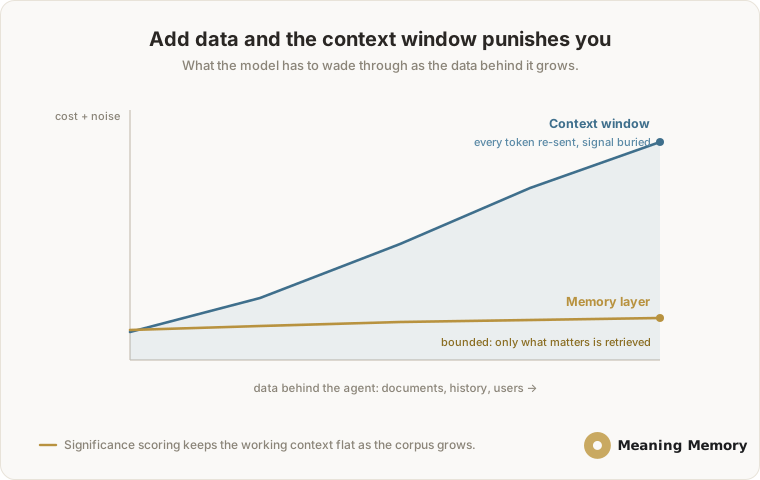 Significance scoring keeps the working context flat as the corpus grows.
7. Decide your build-versus-buy boundary on purpose
There’s a fork in the road here, and it’s worth stopping at. Do you keep your memory inside your own walls, or pipe your company’s collective context into a third party’s cloud? A managed API gets you moving fast, but it also means your most sensitive context now lives somewhere else, and that might be the right trade, as long as it’s one you actually made instead of one you backed into. We chose the self-host route, where the memory runs where your data already lives and we maintain the engine, much the way you already run a database like Neo4j, rather than an API you feed your secrets to.
8. Decide when an agent raises its hand
In a real company, when someone hits a problem they’re not allowed to solve, they don’t keep guessing, they escalate. Agents need the same rule, and it’s an easy one to skip until a support agent is mid-conversation with an unhappy customer, the mood sliding, cheerfully improvising answers nobody signed off on. The org decision is the boundary: what an agent settles on its own, and when it has to pull a person in. The handoff is where memory either earns its keep or gets exposed. The human taking over shouldn’t have to read a twenty-page transcript to catch up, so the agent hands over enough to know what happened, what was promised, what’s still open, and where the facts came from. A good handoff, it turns out, is mostly just memory pointed at the next person in the chain.
9. Onboard a new agent the way you would onboard a new hire
Every new function means standing up an agent, so it should be quick to do, and it shouldn’t start from nothing. You’d never hire someone capable and then tell them nothing about how the place works, but a blank-slate agent on day one is exactly that. The version that finally felt like onboarding instead of configuration was the one where a new agent showed up already holding the company glossary, the current policies, and the past decisions, so its first useful act wasn’t asking the organization to repeat itself. The gap between an agent that starts informed and one that starts empty shows up in the first hour.
10. Treat memory hygiene as an ongoing job
Memory doesn’t stay useful on its own. Leave it alone and it silts up: the agent keeps surfacing the policy you retired in March, the project everyone moved on from, the contact who left, all of it still sitting there looking valid. Teams forget about this because on launch day there’s nothing to see. So we don’t let the store sit still, which means old things fade unless they still matter, the repeated scraps collapse into something cleaner, and a correction actually changes what the agent reaches for next time.
The bigger picture
Notice what’s not on that list: which model to pick. The model is the part you’ll swap most often and think about least. The org design is what decides whether your fleet becomes something you can build on or a pile of agents nobody can quite account for: who knows what, who owes what, who can see what, and who escalates to whom. That gap is most of why we built Meaning Memory instead of stitching it together from the usual parts, which each solved a slice without treating memory as the layer that organizes the whole thing.
The teams that get this right won’t be the ones with the cleverest prompts. They’ll be the ones that treated their agents like a team from the start, gave them a real memory to work from, and drew the org chart before they built the bots. The agents are already in your company, in one form or another. The only question is whether yours are organized, or just busy.
Common questions
How should I organize multiple AI agents? Organize them around business functions rather than around whichever model is current. Map agents to roles the way you map people to roles, so the org chart drives the design. In Meaning Memory each agent gets its own scoped memory, so each function builds its own institutional knowledge without bleeding context into the others.
Can different agents share some memory while keeping the rest private? Yes. Memory is private by default, and sharing is something you declare into a named scope. Some memory stays private to one agent, some belongs to a team, and some is shared, with the boundary enforced in the data itself rather than in a prompt, so you get collaboration where you want it and hard isolation where you need it.
Does a memory layer have to be self-hosted? Meaning Memory is a licensed self-host engine: you run it inside your own infrastructure and we maintain the product. For regulated or sensitive workloads that keeps the memory data on your side of the wall and takes a whole category of residency and compliance questions off the table.
How does a memory layer keep costs from growing with usage? By scoring every memory and returning only what matters for the task in front of the agent. Meaning Memory uses STARE 5D significance scoring so the working context stays about the same size even as the data behind it grows into thousands of documents and years of history.
Want to see it run? The customer kit ships a quickstart that stands up a scoped, multi-agent fleet in a few steps. Request access or email hello@meaningmemory.ai.
Part of the Meaning Memory Explained series.